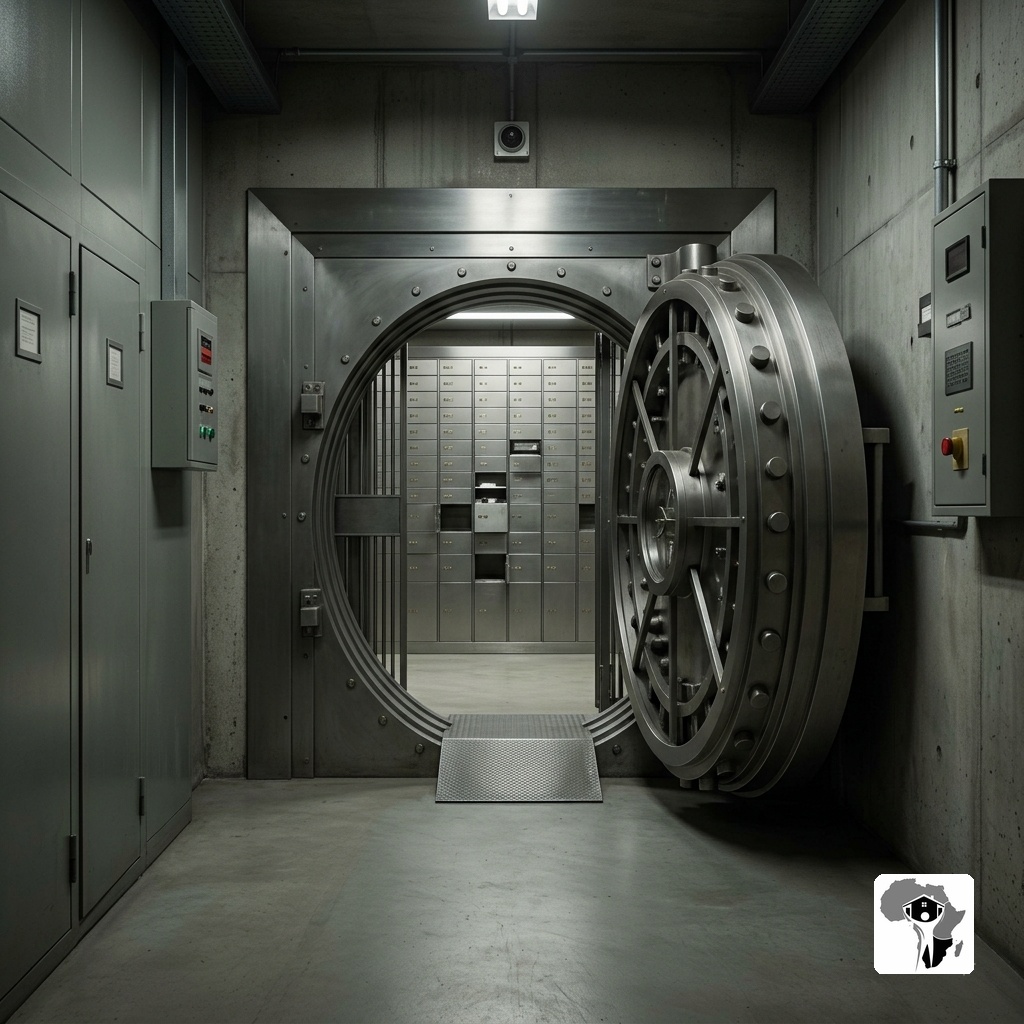
An underground vault involved in the 2003 Antwerp diamond heist. (Digital Illustration: GoBeyondLocal)
Crack the Diamond Vault Without Tripping Sensors
On Monday morning in February 2003, workers at the Antwerp Diamond Centre went down towards a vault beneath the building.
Inside were 189 private safe-deposit boxes used by people working in the diamond trade. By the time the vault was checked, 109 had been emptied.
The thieves had already gone.
The vault was located deep below the Antwerp diamond district behind a massive steel door. Its protection involved several separate systems, including heat detection, motion detection, a magnetic field, radar, seismic sensing, light detection, cameras and a combination mechanism requiring both a code and a key.
For the people who worked in the building, such protection formed part of ordinary life. Access to the vault was restricted, monitored and tied to procedures that had been established long before the robbery.
One man had already found a way to spend time inside that environment.
Leonardo Notarbartolo, an Italian jeweller from Turin, rented an office in the building around 2000. He also had a private safe-deposit box below. His regular presence gave him a reason to enter the building and familiarity with the people working there.
Over the following years, Notarbartolo studied the building and its security. Belgian investigators later linked him to a group known as the School of Turin. The group included people with specialist knowledge of locks, electronics and security systems.
The preparation took a long time. The men observed the vault, studied its protections and worked out ways past the different layers. Some details of the preparation later became disputed, including claims made by Notarbartolo about how the operation was planned.
The robbery took place during the weekend of February 15 and 16, 2003.
The vault was opened without a conventional forced entry. Security systems were bypassed or defeated in succession, allowing the thieves to reach the private boxes. The operation depended on preparation and familiarity rather than smashing through the main door.
Inside the vault, the thieves opened dozens of private boxes. Jewellery, loose diamonds, gold and other valuables disappeared into their bags.
By the time the operation was over, 109 of the 189 boxes had been emptied. Estimates of the stolen property began at more than $100 million, placing the robbery among the largest diamond thefts ever recorded.
The building eventually returned to ordinary activity. Staff discovered the empty boxes, and investigators began examining the vault and the surrounding premises.
The thieves had passed through a heavily protected location, yet the first major lead came from somewhere far away from the underground room.
After the robbery, material linked to the group was discarded outside Antwerp. Among the items were food remains, packaging and documents connected with the operation.
Police examined what had been left behind. One piece of food proved especially useful: a half-eaten sandwich.
Investigators recovered DNA from the discarded food. The evidence helped police connect the material to people associated with the robbery, including Notarbartolo.
The investigation moved from an empty vault towards identifiable suspects.
Notarbartolo was arrested and later convicted for his role in the robbery. He received a 10-year prison sentence.
Other members linked to the operation also faced prosecution. The case had moved far beyond the underground vault, where the theft itself had taken place.
The stolen diamonds created another unanswered problem. Large quantities of the loot were never recovered.
More than two decades after the February 2003 robbery, the Antwerp vault still has a strange distinction: the security systems were defeated, the people involved were identified and prosecuted, yet much of the property taken from those private boxes has never returned to its owners.

Other Dispatches

The 87-Year-Old Man Who Attacked a Judge in Court
8 Sept 2026
The Warehouse That Hid a 600-Yard Drug Tunnel
8 Sept 2026
Holding the Compound Line During a Six Hour Siege
14 Aug 2026
The Tunnel Beneath Two Warehouses
13 Aug 2026
The Imposter Who Posed as Royalty to Steal Millions
13 Aug 2026
Infiltrating an International Cargo Dock Smuggling Ring
12 Aug 2026
Trapped by a Boulder in a Canyon Five Days Alone
10 Aug 2026
Left for Dead on Mount Everest and Walking Back Down
10 Aug 2026
Navigating Fifteen Hundred Miles Across Open Ocean
10 Aug 2026
Four Hundred Days Drifting Across the Pacific Ocean
10 Aug 2026
Seventy Six Days Floating Across the Sea on a Raft
10 Aug 2026