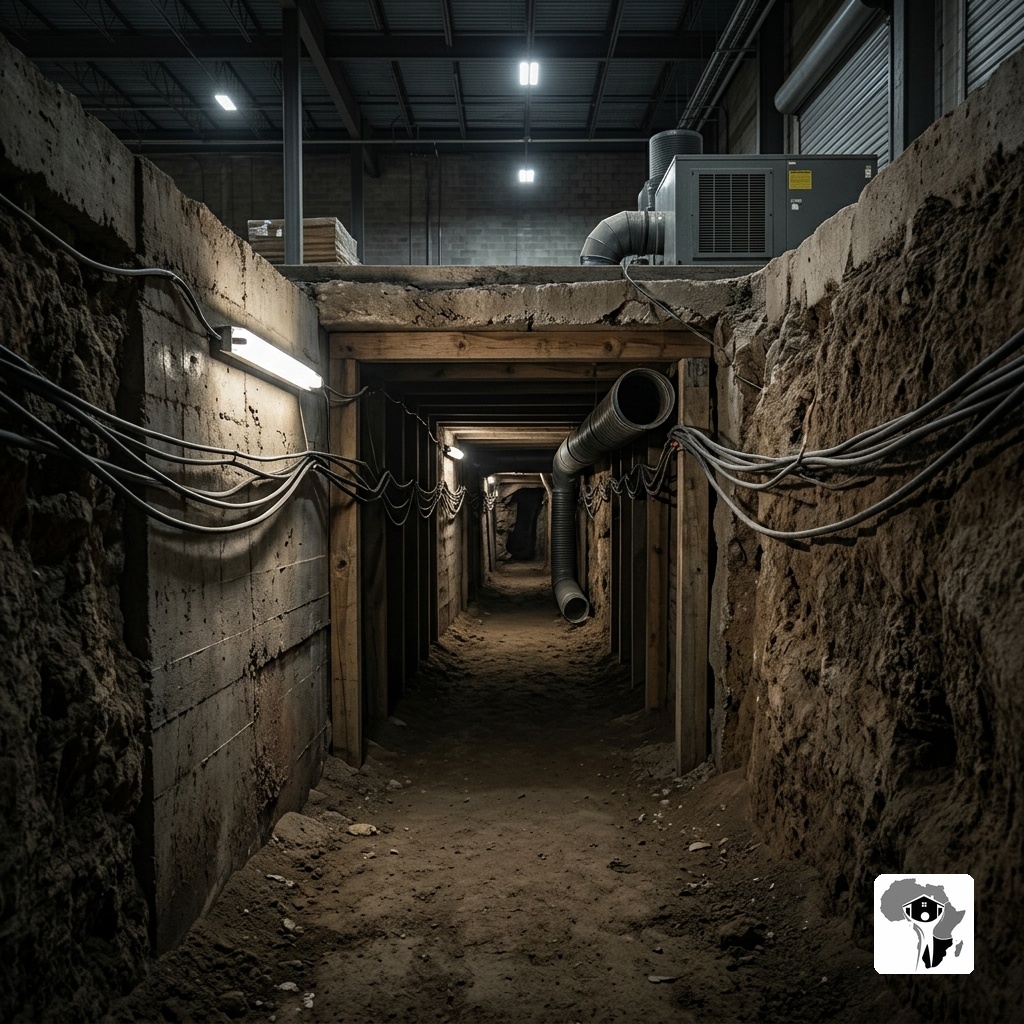
A hidden tunnel beneath the US-Mexico border was used to move drugs between warehouses. (Digital Illustration: GoBeyondLocal)
The Tunnel Beneath Two Warehouses
There was a warehouse on one side of the border and another warehouse on the other.
Between them, beneath the ground, ran a passage built for moving illegal cargo across the international boundary.
The tunnel belonged to a form of smuggling that required more than a vehicle and a driver. Its builders had created an underground route that could move large quantities of drugs without sending the cargo through an official crossing.
Cross-border tunnels had already become familiar to investigators along the United States-Mexico border. Some were crude openings in the ground. Others were narrow passages through which people had to crawl. A smaller number had electricity, ventilation and enough space for organised movement.
The underground routes offered smugglers another way to bypass roads, checkpoints and the ordinary traffic associated with legal border crossings.
By the late 2000s, authorities had found dozens of such passages along the border, particularly around Arizona and California.
San Diego had become one of the places where the underground trade could be seen in a different form.
Warehouses on opposite sides of the border could provide useful cover for a passage running beneath the international boundary. From the surface, the buildings could look like ordinary commercial properties. Beneath them, the arrangement could serve a very different purpose.
Investigators eventually encountered one of the more sophisticated examples.
The passage connected warehouse properties in the San Diego and Tijuana area.
Its construction required more planning than a simple hole dug beneath the border. The tunnel belonged to an underground system designed to move contraband between two countries while keeping the activity out of sight.
For investigators, finding the entrance was only part of the task. The full passage had to be examined, and the operation connected to it had to be identified.
The discovery came in November 2010.
Agents entered the tunnel and found a passage associated with a large drug-smuggling operation. The scale of the seizure gave the underground route a different dimension from the small passages that could carry only limited loads.
More than 20 tons of marijuana were seized.
The tunnel also linked the investigation to people who could be held responsible for the operation.
Eight arrests followed the discovery.
The seizure and arrests turned an underground passage into evidence of a much larger criminal enterprise. The tunnel had provided the route, while the warehouses offered places on the surface where cargo could be handled after crossing the border.
The passage was also significant because it was the second major cross-border drug tunnel found in the same San Diego-area location.
That detail gave investigators another piece of information about the geography of the trade. A single location could support repeated attempts to move narcotics beneath the border.
The underground route was part of a wider pattern.
Along the United States-Mexico border, investigators had encountered tunnels ranging from crude passages to elaborate underground corridors fitted with electricity and ventilation. Some discoveries followed direct law-enforcement work. Others began with municipal work, surveillance, information from people or physical signs on the surface.
In Nogales, Arizona, for example, a sinkhole in a city street once led officials to ask Border Patrol agents to investigate. The inspection uncovered a tunnel beneath the street.
Other passages were found after surveillance activity or through cooperation between agencies on both sides of the border.
The San Diego tunnel belonged to the more sophisticated end of that underground trade.
Its existence showed how a border could be crossed without a truck approaching a checkpoint or a courier walking through an official entry point. The cargo could move below the surface and emerge inside a warehouse.
By the time the authorities had seized the marijuana and arrested eight people in November 2010, the passage had served its purpose. The route beneath the border had become the evidence that exposed the operation.

Other Dispatches

Holding the Compound Line During a Six Hour Siege
14 Aug 2026
The Imposter Who Posed as Royalty to Steal Millions
13 Aug 2026
Infiltrating an International Cargo Dock Smuggling Ring
12 Aug 2026
Trapped by a Boulder in a Canyon Five Days Alone
10 Aug 2026
Left for Dead on Mount Everest and Walking Back Down
10 Aug 2026
Navigating Fifteen Hundred Miles Across Open Ocean
10 Aug 2026
Four Hundred Days Drifting Across the Pacific Ocean
10 Aug 2026
Seventy Six Days Floating Across the Sea on a Raft
10 Aug 2026
A Suspect Vanishes During a Bank Sting
10 Aug 2026
How Suspected Looters Were Wrapped to Street Poles in Ukraine
10 Aug 2026
How a Forgotten Knife Sheath Caught a Hidden Killer
10 Aug 2026



.webp)