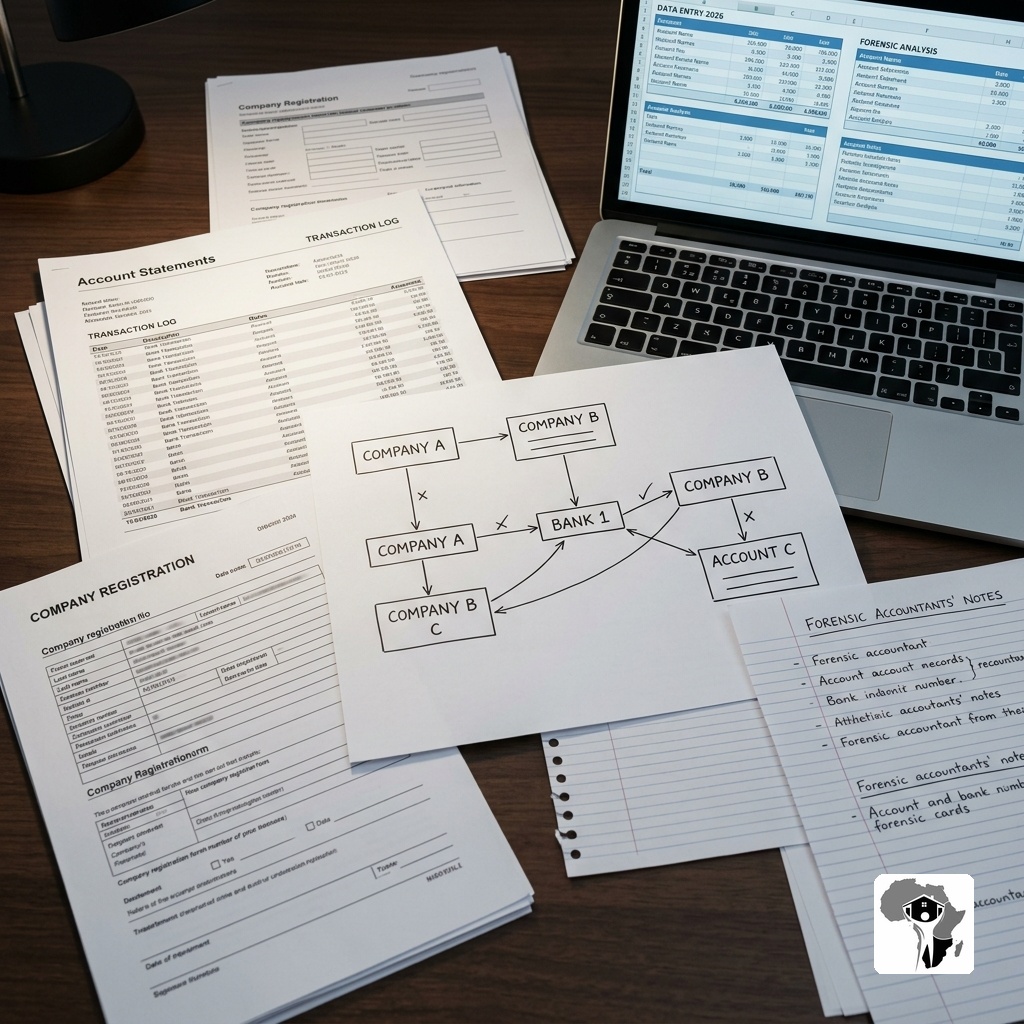
Financial records helped investigators trace payments through a network of offshore companies. (Digital Illustration: GoBeyondLocal)
Tracing Hidden Offshore Accounts to Shadow Companies
The money appeared in one account and disappeared into another.
On paper, each transfer belonged to a different company. The names changed as the payments moved through the financial system, creating distance between the money and the people who controlled it.
Investigators followed the records one transaction at a time.
The first account gave investigators only part of the picture. A payment had moved through a company whose name appeared legitimate, but the records pointed towards another business behind it.
That second company led to another account. The same pattern appeared again: a corporate name, a bank account and another transfer carrying the money farther from its original source.
The investigation began to depend on connections between records rather than a single suspicious payment.
Forensic accountants examined the dates, amounts and destinations of the transfers. They compared bank records with company registrations and ownership information.
Some companies existed in one jurisdiction while their accounts were held somewhere else. Corporate structures placed additional names between the accounts and the people who ultimately controlled them.
The records created a financial map that grew with each transaction.
A payment leaving one account could be matched with a deposit elsewhere. Another transfer followed days or weeks later. Several transactions eventually connected companies that appeared separate when viewed individually.
The accountants followed those links back through the corporate structure, separating genuine business activity from transactions that existed mainly to move money from one place to another.
The work required patience because each company created another layer for the investigators to examine.
Company documents provided another set of clues. Names appearing as directors, shareholders or authorised representatives could be compared across businesses.
A person connected with one company could also appear in records belonging to another. Addresses, telephone details, bank relationships and registration information added further connections.
What looked like several unrelated businesses began to form a single network in the records.
The offshore accounts made the trail harder to follow because the money had crossed borders and passed through different corporate structures.
Investigators had to obtain records from more than one jurisdiction before they could see how the transactions fitted together. Each document answered one question and raised another: who had authorised the transfer, who controlled the receiving company and where did the money go afterwards?
The answers came from comparing records rather than relying on the name printed on an account.
As the accountants reconstructed the payments, some transactions led back to companies with little visible commercial activity. Their names appeared in the paperwork, yet the financial records showed activity that mattered far more than the businesses appeared to conduct in public.
The companies had served as layers between the money and its source.
Following those layers brought investigators closer to the people behind the accounts.
The financial trail eventually connected the offshore accounts to the wider corporate network under investigation.
Bank records, company documents and transaction histories could now be read together. Payments that had once appeared isolated formed part of a sequence linking accounts, companies and individuals.
The hidden structure had become visible through its own paperwork.
Investigators continued tracing the money until the corporate layers led back to the people who controlled the network.
The work had started with transactions that appeared to belong to separate accounts. By following each payment through the companies attached to it, forensic accountants turned those separate records into a connected financial trail.

Other Dispatches
The Tunnel Beneath Two Warehouses
13 Aug 2026
The Imposter Who Posed as Royalty to Steal Millions
13 Aug 2026
Infiltrating an International Cargo Dock Smuggling Ring
12 Aug 2026
Trapped by a Boulder in a Canyon Five Days Alone
10 Aug 2026
Left for Dead on Mount Everest and Walking Back Down
10 Aug 2026
Navigating Fifteen Hundred Miles Across Open Ocean
10 Aug 2026