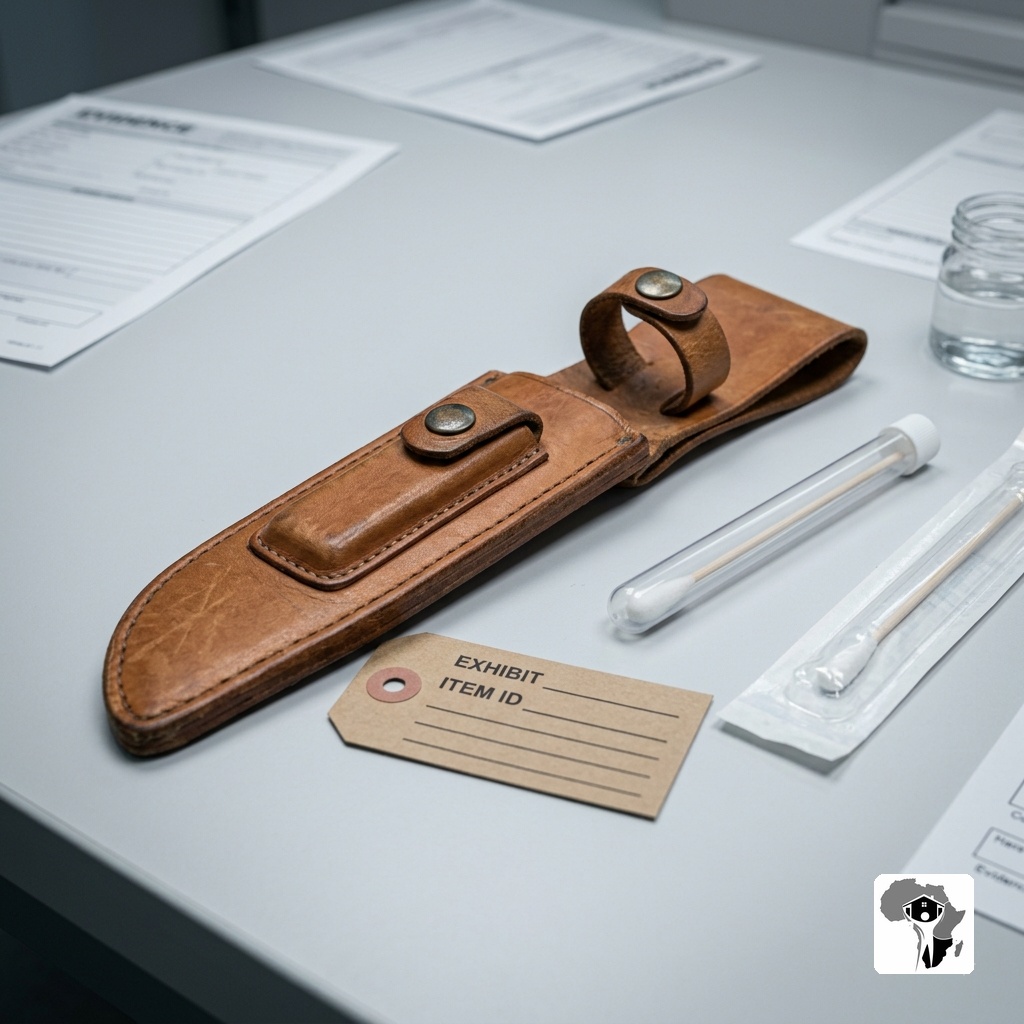
A knife sheath became a key piece of forensic evidence in the investigation into four killings in Moscow, Idaho. (Digital Illustration: GoBeyondLocal)
How a Forgotten Knife Sheath Caught a Hidden Killer
On November 13, 2022, investigators entered a house on King Road in Moscow, Idaho, after four University of Idaho students were found dead inside.
Among the objects recorded inside was a tan leather knife sheath. It lay near Madison Mogen, one of the four victims.
The sheath held a small piece of biological evidence.
The house had become a crime scene after Madison Mogen, Kaylee Goncalves, Xana Kernodle and Ethan Chapin were killed in the early morning hours. Police began documenting rooms, objects and traces that could help reconstruct what had happened.
The sheath drew attention because it was associated with the type of knife believed to have been used in the killings. Its metal snap also provided a surface for forensic testing.
Investigators collected material from the sheath and sent samples for laboratory examination. One sample from the strap and buckle area produced a DNA profile that could be compared with other genetic material.
Several additional samples from different parts of the sheath produced mixed or insufficient material for comparison. The useful sample came from a specific area of the object.
The laboratory comparison gave investigators a male genetic profile. At that stage, the profile supplied a direction for the investigation rather than a name.
Investigators needed to determine whose DNA it was.
The search widened beyond the house in Moscow. Investigators examined people and places connected with the case while working through other evidence from the crime scene and surrounding area.
Surveillance footage also drew attention to a white Hyundai Elantra seen near the house around the time of the killings. Investigators later connected that vehicle to a Washington State University student named Bryan Kohberger.
Kohberger lived in Pullman, Washington, less than an hour from Moscow. He was a doctoral student in criminology at Washington State University.
His name gave investigators a person whose genetic material could be compared with the profile recovered from the sheath.
A direct reference sample from Kohberger was still required. Investigators eventually obtained genetic material connected to him through a separate route.
Before that direct comparison, investigators used genetic genealogy to narrow the family line associated with the sheath profile. The search led towards the family of Kohberger.
Investigators then watched the Kohberger family home in Pennsylvania. Agents collected discarded material from household rubbish, including a swab recovered from a trash container.
The genetic material from that item provided a family connection to the DNA recovered from the knife sheath.
The investigation moved from a small trace on a leather sheath to a specific family line, and from that family line to a particular man.
Kohberger was arrested in Pennsylvania on December 30, 2022, 47 days after the killings in Moscow.
The case against him contained more than the sheath. Investigators had also gathered vehicle information, surveillance footage and cellphone data that placed Kohberger in the broader picture surrounding the crime.
The sheath, however, had supplied the genetic link that gave investigators a route towards his identity.
For years, the prosecution and defence argued over what the sheath DNA could establish. Defence experts challenged the handling and interpretation of the evidence, while prosecutors presented the DNA connection as part of a larger body of evidence.
Laboratory records later documented that DNA recovered from the strap and buckle area of the sheath was connected to Kohberger through DNA comparison.
The case eventually reached court. In July 2025, Kohberger pleaded guilty to four counts of first-degree murder and one count of burglary.
He received four consecutive life sentences without the possibility of parole, along with an additional ten-year sentence for burglary.

Other Dispatches

Holding the Compound Line During a Six Hour Siege
14 Aug 2026
The Tunnel Beneath Two Warehouses
13 Aug 2026
The Imposter Who Posed as Royalty to Steal Millions
13 Aug 2026
Infiltrating an International Cargo Dock Smuggling Ring
12 Aug 2026
Trapped by a Boulder in a Canyon Five Days Alone
10 Aug 2026
Left for Dead on Mount Everest and Walking Back Down
10 Aug 2026
Navigating Fifteen Hundred Miles Across Open Ocean
10 Aug 2026
Four Hundred Days Drifting Across the Pacific Ocean
10 Aug 2026
Seventy Six Days Floating Across the Sea on a Raft
10 Aug 2026
A Suspect Vanishes During a Bank Sting
10 Aug 2026
How Suspected Looters Were Wrapped to Street Poles in Ukraine
10 Aug 2026